Class A Fire Certification: Why Your Rooftop Solar System Needs to Be a Safety Shield, Not a Fuel Source
If you follow commercial property insurance trends, you already know the ground rules are changing. The 2026 Solar Risk Assessment by kWh Analytics dropped a massive reality check on the industry: 84% of solar PV fire events are equipment-driven brushfires, not external wildfires. This means the threat isn't coming from the forest down the road; the risk originates right there on the roof, usually triggered by sub-optimal connectors, fuses, or inverter failures. Even worse, industry data shows that 79% of high-risk connector failures show no thermal signatures during routine inspections, making them invisible until an arc occurs.
When an electrical arc happens under a solar array, a standard panel can act like a tent, trapping the heat and channeling flames directly onto your facility's roof deck. That's why looking at a component datasheet and seeing a generic "fire rating" isn't enough anymore. You need to know how the entire roof assembly behaves under stress.
Let's break down the engineering reality of fire certifications and look at how HOOGO's system-level design acts as a genuine safety shield for your facility.
Q1: What is the massive gap between "Component-Level" and "System-Level" fire testing?
Most standard solar panels on the market carry a basic fire rating under standards like UL 790 or standard IEC baseline qualifications. But here is the catch: those tests primarily evaluate the PV module as a standalone product in a controlled laboratory setup.
The testing laboratory applies a flame to a single piece of glass and laminate to see if it ignites or drops burning debris. While this is an essential baseline qualification for manufacturing, it completely ignores how solar panels are actually installed in the real world.
In a real C&I installation, you don’t have a standalone module floating in mid-air. You have rows of modules mounted a few inches above a commercial roofing membrane, held together by aluminum rails, structural brackets, and specialized clamps.
When an arc fire breaks out underneath the panels, that narrow gap creates a chimney effect. The flames don't just hit the module; they bounce off the backsheet, superheat the air cavity, and attack the roof deck. A standalone component certification cannot tell you if that combined setup will burn your building down.
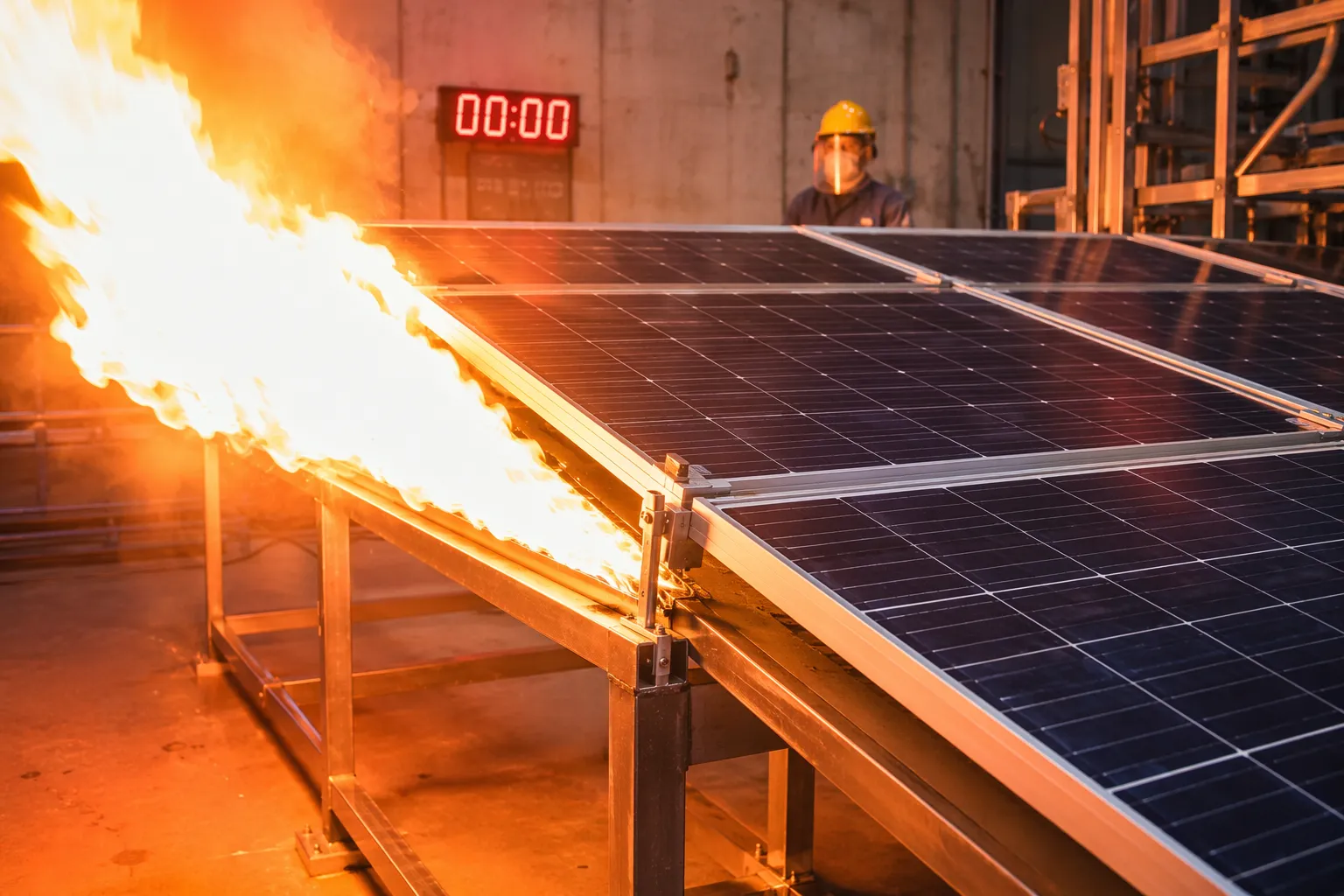
Q2: How does the FM 4478 Class A fire test simulate real-world roof disasters?
This is where FM 4478 changes the game. Administered by FM Approvals (part of the FM Global system), this standard is rooted strictly in property loss prevention. It doesn't care how a component performs in isolation; it tests the complete, integrated hardware assembly.
When HOOGO submitted its system for the FM 4478 Class A fire spread test, the engineers didn't just test a panel. They built a full-scale mockup of a complete roofing system, replicating the exact interface of:
The specific industrial roof deck and membranes,
The mounting rails and structural brackets,
HOOGO's precision-engineered structural clamps,
And the HOOGO PV modules.
During the test, the assembly is subjected to severe flame exposure from above the roof deck under high-velocity wind conditions. To secure a Class A Fire Rating—the highest possible safety classification—the complete assembly must prove that it restricts flame spread across the roof deck, prevents ignition of the underlying structure, and produces no flying brands or burning embers.
HOOGO passed this rigorous protocol because our system is designed to stop flame propagation across the roof envelope, acting as an engineering barrier rather than a conduit for fire.
Q3: Why is a system-level fire rating the key to project bankability in 2026?
Commercial property insurers are managing billions of dollars in renewable energy loss data, and they are tightening their underwriting criteria. If your project relies on mismatched, unverified hardware—where panels come from one vendor and universal mounting kits from another—underwriters treat that assembly as a high-risk liability.
By deploying an integrated system that carries a validated FM 4478 Certificate of Compliance, you change the financial conversation. You provide underwriters with empirical, data-driven proof that the solar array and the building envelope work in harmony to mitigate property loss. This level of risk management is a powerful tool for lowering annual insurance premiums and unlocking smoother project financing terms.
Q4: How does HOOGO integrate fire safety without risking your roof's warranty?
A common mistake in C&I procurement is buying components that compromise the building's structural integrity. If a solar mounting supplier uses low-grade universal clamps, thermal expansion and mechanical stress can puncture the roofing membranes over time, creating a clear pathway for both water leaks and localized electrical faults.
HOOGO addresses this by rejecting generic hardware. We partner directly with premium roofing system OEMs, such as BlueScope and Butler. Every fastener, bracket, and clamp in the HOOGO FM Approved system is engineered to adapt to the thermal and structural characteristics of these specific roof decks.
This means we don't just protect the modules from electrical hazards; we keep the entire building envelope sealed and structurally sound, ensuring your original roof warranty remains fully intact over its 25-year lifecycle.
Summary Checklist: Evaluating Rooftop Fire Risks
Fire Risk Factor | Standard Component Approach (IEC/UL Baseline) | HOOGO Integrated Approach (FM 4478 Class A) |
Testing Scope | Stands alone; ignores mounting and roof deck interfaces. | Full System Assembly (Deck + Clamps + Rails + Modules). |
Ignition Mitigation | Validates material safety under lab conditions. | Halts Flame Spread across the actual roof during active arcs. |
Wind & Fire Interaction | Not evaluated simultaneously in standard component tests. | Tested under dynamic wind loads to simulate real rooftop drafts. |
Insurance Position | Treated as standard baseline compliance. | Preferred by Underwriters; aligned with FM Global standards. |
Roof Compatibility | High risk of mismatched hardware and warranty voiding. | OEM-Verified Integration with Butler/BlueScope systems. |
The Bottom Line: Look at the Whole Roof
When investing in an industrial rooftop solar project, you aren't just buying an electricity generator—you are developing a complex property asset. An isolated fire rating on a panel datasheet won't protect your facility if an invisible connector fault occurs under the array.
By certifying the entire hardware matrix to the uncompromising requirements of FM 4478 Class A, HOOGO ensures that if the unexpected happens, your solar system behaves like a shield, protecting your building, your operations, and your bottom line.
Want to verify how an FM Approved solar assembly aligns with your current property insurance policy?
[Contact HOOGO's Technical Engineering Team for a Custom Fire Safety & Roof Integration Assessment]
Related Products
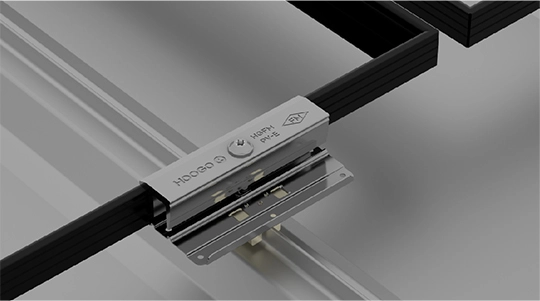
FM Approved Roof-Mounting PV Module Systems
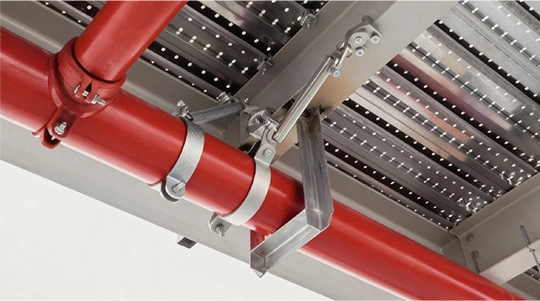
FM Approved Seismic Bracing Systems
FM Approved Flood Barrier System
ETA Certified Anchor Fixing System
TUV Certified Flexible Barrier System